

Torsion Spring
Your Leading KC Supplier
KC is a high-tech enterprise that manufactures hardware products for stamping, machining, turning, and wire forming, especially in stamping and turning processes, wire forming and turning. Strict quality control is ensured & customization is welcomed.
Why Choose Us
100% Satisfaction Guarantee
We're so confident you'll be happy with our services, we guarantee it.
Extensive Experience
Our team of professionals have been in the business for quite some time. Let us deliver solutions that work the first time!
Fair & Competitive Pricing
Our pricing structure is designed to make a modest profit so that we can continue to be a Hero another day.
-
![Double Torsion Springs]() Double Torsion SpringsDouble torsion spring is a specially designed spring product. Its unique double helix structure makes it highly torsional elastic. This kind of spring is often used in applications that need to...read more
Double Torsion SpringsDouble torsion spring is a specially designed spring product. Its unique double helix structure makes it highly torsional elastic. This kind of spring is often used in applications that need to...read more -
![Brake Spring]() Brake SpringBrake Spring is a high-performance spring product specially designed for automobile braking systems. As one of the key components in the automobile braking system, Brake Spring is made of...read more
Brake SpringBrake Spring is a high-performance spring product specially designed for automobile braking systems. As one of the key components in the automobile braking system, Brake Spring is made of...read more -
![Stainless Steel Torsion Spring]() Stainless Steel Torsion SpringStainless steel torsion spring is a type of mechanical spring widely used in various industrial applications. Its unique design and material selection make it an ideal choice in many fields....read more
Stainless Steel Torsion SpringStainless steel torsion spring is a type of mechanical spring widely used in various industrial applications. Its unique design and material selection make it an ideal choice in many fields....read more -
![Torsion Springs Design]() Torsion Springs DesignTorsion springs design are a spring solution designed to meet the unique needs of our customers. Whether in terms of size, shape or material, this product offers a high degree of customization to...read more
Torsion Springs DesignTorsion springs design are a spring solution designed to meet the unique needs of our customers. Whether in terms of size, shape or material, this product offers a high degree of customization to...read more -
![Automotive Springs]() Automotive SpringsAutomotive springs are a key suspension system component that provide stability, handling and comfort to your vehicle. As an important part of the vehicle suspension system, automobile torsion...read more
Automotive SpringsAutomotive springs are a key suspension system component that provide stability, handling and comfort to your vehicle. As an important part of the vehicle suspension system, automobile torsion...read more -
![Galvanized Wire Springs]() Galvanized Wire SpringsGalvanized spring wire is a high-strength spring wire that has been galvanized and is widely used in various industrial and construction fields. It is made of high-quality steel and is galvanized...read more
Galvanized Wire SpringsGalvanized spring wire is a high-strength spring wire that has been galvanized and is widely used in various industrial and construction fields. It is made of high-quality steel and is galvanized...read more -
![Spiral Torsion Spring]() Spiral Torsion SpringThe spiral torsion spring is an efficient and widely used spring in mechanical systems. Its unique design provides excellent torsional performance. This torsion spring plays an important role in...read more
Spiral Torsion SpringThe spiral torsion spring is an efficient and widely used spring in mechanical systems. Its unique design provides excellent torsional performance. This torsion spring plays an important role in...read more -
![Metal Spring Clip]() Metal Spring ClipMetal Spring Clip is a versatile fixture commonly used to clamp, secure or connect objects. Its design is simple but powerful, suitable for various application scenarios.read more
Metal Spring ClipMetal Spring Clip is a versatile fixture commonly used to clamp, secure or connect objects. Its design is simple but powerful, suitable for various application scenarios.read more


Advantages of Torsion Spring
Compact Design
Torsion springs are typically more compact and space-efficient than other types of springs, such as compression or extension springs, making them suitable when limited space is available.
Versatility
Torsion springs are versatile and can be customized in size, material, and design to suit various industries, from automotive components to industrial machinery.
Smooth and Controlled Motion
Torsion springs provide smooth and controlled rotational motion, which is crucial when jerky or sudden movements are undesirable.
Consistent Force
Torsion springs can provide a consistent and reliable force throughout their operating range, making them suitable when constant torque or tension is required.
Adjustable Torque
The torque output of torsion springs can often be adjusted by changing parameters like the wire diameter, coil diameter, or the number of coils, allowing for customization to meet specific requirements.
Reliable for Repetitive Cycles
Torsion springs are well-suited for many repetitive cycles, as they can maintain their performance characteristics over many cycles without significant degradation or failure.
A torsion spring is a spring that works by twisting its end along its axis; that is, a flexible elastic object that stores mechanical energy when it is twisted. When it is twisted, it exerts a torque in the opposite direction, proportional to the amount (angle) it is twisted. There are various types:
A torsion bar is a straight bar of metal or rubber that is subjected to twisting (shear stress) about its axis by torque applied at its ends.
A more delicate form used in sensitive instruments, called a torsion fiber consists of a fiber of silk, glass, or quartz under tension, that is twisted about its axis.
A helical torsion spring, is a metal rod or wire in the shape of a helix (coil) that is subjected to twisting about the axis of the coil by sideways forces (bending moments) applied to its ends, twisting the coil tighter.
Clocks use a spiral wound torsion spring (a form of helical torsion spring where the coils are around each other instead of piled up) sometimes called a "clock spring" or colloquially called a mainspring. Those types of torsion springs are also used for attic stairs, clutches, typewriters and other devices that need near constant torque for large angles or even multiple revolutions.
Applications of Torsion Springs
Some of the products which utilize torsion springs are the following:
Clock Springs in Vehicles
A clock spring is usually found inside the steering mechanism of automotive vehicles, specifically between the steering wheel and the steering column. It maintains all the electrical connections of the airbag, horns, radio, and steering mechanism electrical systems linked to the steering wheel. The clock spring allows the steering wheel to be rotated many times and in different directions without damaging the electrical wiring of those systems. As the steering wheel is rotated, the spiral winding of the clock springs will coil or uncoil around a disc. If those electrical wirings are unsupported by a clock spring, they will get tangled and damaged when the steering wheel is operated.
The other names of clock springs in vehicles are spiral cables, coil spring unit, coil assembly, cable reel assembly, contact reel, and airbag clock spring (for vehicles equipped with airbags). Despite being known in several names, the function of clock springs is the same in all vehicles.
Clothespins and Clipboards
Clothespin is the simplest application of torsion springs. Torsion springs cause the prongs of the clothespin to open and grip the cloth once the finger pressure is released. The same mechanism is applied to the clips of clipboards.
Spring-Loaded Hinges
Spring-loaded hinges have a torsion spring inserted through the knuckles, and the legs of the torsion spring are attached to the rectangular plates. The torsion spring provides a self-closing mechanism on the residential, commercial, automobile, agricultural vehicles, and garage doors and compartments once the force applied on the door is released. Hence, the door remains closed once when it is not being used. The spring in the hinge may be configured such that the door is statically held to stay open.
Clock spring
Clock springs, or main spring, are a type of spiral wound torsion spring. This spring is known to provide constant force output, and it can make large angular deflections of many revolutions while having a little variation in torque. Clock springs are available in square, rectangle, and D-shaped inside diameters.
Mechanical watches are a popular application of clock springs. The clock spring stores energy as it is rotated by a knob. The stored energy in the clock spring moves the clock’s wheels as it unwinds until the next winding is needed. This application is adapted in the operation of clocks, watches, timers, metronomes, wind-up toys, and music boxes.
Torsion Bar Suspension
Torsion bar suspensions are torsion bars used in automobiles that support the trailing arms when lateral or vertical forces are applied to the wheels. Under such circumstances, the torsion bar twists around its axis to avoid deflection in the trailing arms.
Torsion Springs have a variety of uses as their impressive rotational energy allows for a transferrable mechanism that can be integrated into many different products.
Firstly, they are commonly used in large vehicles such as trucks, SUVs, or vehicles that generally transport a lot of weight. This is so that the manufacturers can easily change the torsion bars. They do this to change the ride height or compensate for engine weight.
An advantage of torsion springs in vehicles is the durability of the torsion bar as its mass allows it to handle a lot of stress. This is demonstrated by its use in many military vehicles, such as the M1 Abrams tank which has stood the test of time since its development in 1979.
Another popular use for torsion springs is their application within garage doors. The springs are tightly wound around a metal shaft that is connected to a cable drum when the garage door is opened. The tension is released and it spins the shaft, turning the cable drums by wrapping around the drums and raising the door.
When the garage door is closed it winds the torsion spring back around the metal shaft and restores the tension. These springs generally last for around 30,000 cycles; a full cycle consists of both the opening and closing of the garage door.
Torsion springs are also used in the hinges of many doors as it allows them to close after being opened without electronic technology. In theory, it is quite a simple design; the torsion spring is attached to a hinge with one side connected to the stationary plate on the wall and the other side connected to the moving plate on the door.
This means that when the door is opened the pressure applies tension to the torsion spring and once the door is released the rotational energy moves the door back into place.

What Are Torsion Springs Made Of?
Torsion springs are crafted from a variety of materials, each chosen for specific applications based on their properties. The most common materials used for torsion springs include
Spring Steels: These steels are renowned for their pliability, high resilience, and strength. They can be extended, compressed, bent, and twisted to their elastic limit and return to their original shape without deformation. Spring steels have high fatigue strength and durability, and are cost-effective. This category includes high-carbon spring steels, such as oil-tempered wire, hard-drawn wire, music wire, and flat cold-rolled spring steel.
Stainless Steels: Stainless steels offer remarkable mechanical properties, similar to spring steel, along with better corrosion resistance. Common stainless steel grades used in torsion springs include Grade 17-7 PH, Grade 316, Grade 304, and Grade 302.
Alloy Spring Steels: Alloy spring steels are modified with elements like: manganese, vanadium, silicon, nickel, chromium, and molybdenum to get a higher elastic limit. This makes them well-suited for demanding high-impact and shock scenarios. Examples of alloy spring steels used in torsion springs are silicon manganese, chrome silicon, and chrome vanadium.
Copper-Based Alloys: Copper-based alloys, like phosphor bronze, spring brass, beryllium copper, offer excellent corrosion resistance and electrical properties. These materials can perform well in subzero temperatures and have high ductility and strength, although they tend to be pricier than other materials.
Nickel-Based Alloys: These alloys, such as: A 286, provide exceptional corrosion resistance. They are also able to withstand elevated and subzero temperatures, so are commonly found in harsh environments. Nevertheless, their notable electrical resistance makes them unsuitable for use in electrical applications.
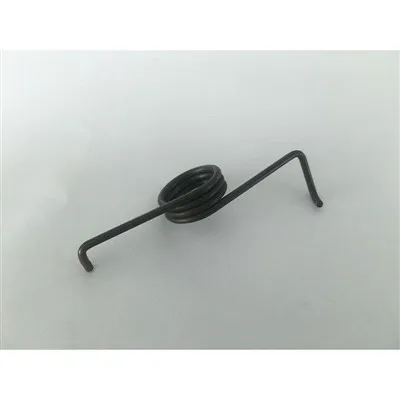
Torsion springs function by storing and releasing energy through the application of a twisting or rotational force around their axis. These springs consist of coiled wire, with one end anchored to a fixed point and the other end attached to a rotating (or movable) point or mechanism. When the rotating point is twisted, the spring stores potential energy by coiling tighter, imparting stress on the spring. This twisting motion resists the applied rotational force, with the wire winding around the spring’s axis. The more the spring is twisted, the more energy it stores. Upon release of the rotational force, the torsion spring unwinds, returning to its original position, and in the process, it releases the stored energy. This released energy generates torque and can be used to move or hold mechanical components in place.
types of CNC machining
Springs are ubiquitous in modern engineering and technology, playing a critical role in various applications, from door hinges to automotive suspensions. Two common types of springs are torsion springs and compression springs. Each type has its own unique characteristics and applications, making the choice between them crucial for the success of your project. In this article, we’ll explore the differences between torsion springs and compression springs, helping you make an informed decision for your specific project.
Torsion Springs:
Torsion springs are designed to store and release rotational energy. They work by twisting or rotating around an axis, exerting torque when the angle of rotation changes. Torsion springs are typically made from materials like stainless steel, music wire, or even various alloys, depending on the desired properties.
Applications:Torsion springs are commonly found in applications where rotational force is required, such as:
Garage Doors: Torsion springs play a crucial role in counterbalancing the weight of garage doors, making them easier to open and close.
Clothespins: The simple torsion spring design in clothespins allows them to hold garments securely.
Clipboards: Torsion springs are used in clipboards to hold papers in place.
Vehicle Suspensions: Some vehicle suspensions use torsion bars to provide smooth rides and better control.
Advantages:
Torsion springs offer several advantages:
Compact Design: Torsion springs can store a significant amount of energy in a compact space, making them suitable for applications with limited room.
Precise Control: The torque exerted by torsion springs can be precisely controlled by adjusting the spring’s dimensions and material properties.
Durability: Torsion springs are known for their durability and ability to withstand repeated loading and unloading cycles.
Compression Springs:
Compression springs, on the other hand, are the most common and recognizable type of spring. They are designed to resist axial compressive forces and return to their original length when the force is removed. These springs are typically made from materials like steel, which provide the required flexibility and strength.
Applications:
Compression springs are widely used in applications that require linear force or shock absorption, including:
Automotive Suspension: Compression springs are integral components of vehicle suspension systems, absorbing shocks and providing a smoother ride.
Mattresses: These springs are often used in mattresses to provide comfort and support.
Valves: Compression springs are used in various valves to control fluid flow.
Pens: The click mechanism in retractable pens uses compression springs to create tension.
Advantages:
Compression springs offer several advantages:
Wide Range of Sizes: These springs come in a wide variety of sizes, making them suitable for various applications, from miniature devices to heavy machinery.
Simple Installation: Installing compression springs is relatively straightforward, making them easy to integrate into designs.
Cost-Effective: Due to their simple design and widespread use, compression springs are often more cost-effective than other types.
Choosing the Right Type for Your Project:
The choice between torsion springs and compression springs largely depends on the specific requirements of your project:
Type of Force: Consider whether your application requires rotational force (torsion) or linear force (compression). For example, if you need a door to open and close smoothly, a torsion spring might be more suitable. If your goal is to absorb shocks, a compression spring might be the better choice.
Space Constraints: If your project has limited space, torsion springs are beneficial due to their compact design. Compression springs might be better suited for applications with more room.
Materials and Durability: Evaluate the environmental conditions and lifespan your springs will be subjected to. Torsion springs might be more appropriate for applications requiring high durability and resistance to repeated use.
Ease of Installation: If ease of installation is important, compression springs are generally simpler to incorporate into designs.
Customization: Both types of springs can be customized to meet your project’s needs. Consulting with spring manufacturers or engineers can help you determine the best design for your application.
Our Factory
KC is a high-tech enterprise that manufactures hardware products for stamping, machining, turning, and wire forming, especially in stamping and turning processes, wire forming and turning. Strict quality control is ensured & customization is welcomed.


Certificate

FAQ
Q: What happens if torsion spring is broken?
Q: What is the difference between a torsion spring and a tension spring?
Torsion springs and tension springs sound similar but they are quite different. On a garage door, for example, torsion springs will extend less than a tension spring, as torsion springs turn and tension springs fully expand and contract.
Q: How much does it cost to convert a torsion spring?
For residential garage door springs, you'll pay anywhere from $50 to $100 per spring for extension springs, including labor fees. Torsion springs cost between $75 and $150 for both the spring and labor. To switch from extension to torsion springs, expect to pay between $400 and $800.
Q: Will garage door fall if torsion spring breaks?
Q: What is an alternative to a torsion spring?
Q: Why does torsion spring break?
Q: What is the average life of a torsion spring?
Torsion springs usually have 5,000-20,000 cycles which means they can last between 7 to 12 years (and even more). Extension Springs' Life Expectancy: Extension springs are installed at the side of the door and act extend, rather than contract (as does the torsion spring).
Q: How often do torsion springs need to be replaced?
Q: Do torsion springs wear out?
Q: Can I put a heavier torsion spring on my garage door?
Q: Can you tighten a torsion spring?
Q: Can you repair a torsion spring?
Q: Should I replace both torsion springs?
Improperly balanced springs can cause damage to your garage door or even cause serious injury. Be sure to replace both springs, not just one, if they are broken. This will keep your springs balanced and your garage door running smoothly, increasing the lifespan of your door.
Q: Can you manually open a garage door with a broken torsion spring?
Q: How long does it take to replace a torsion spring on a garage door?
Q: What do the colors mean on garage door torsion springs?
Q: Are all garage door torsion springs the same?
Q: Can you bend a torsion spring?
Q: Can you use torsion spring in both directions?
Q: What is the difference between a clock spring and a torsion spring?
We're well-known as one of the leading torsion spring manufacturers and suppliers in China. Please rest assured to buy high quality torsion spring for sale here and get quotation from our factory. For customized service, contact us now.
Spring Clip Fasteners, Copper Component, single coil torsion spring